 هاتف : +86 595 87817505
 جوال : +86 13799577570
 البريد الإلكتروني : robin@hiway-bags.com




Introduction: Why Hiking Packs Are the Hardest Category to Buy Well
At a trade fair, four hiking backpacks can look almost identical from two metres away. The quoted prices are not: a 40% spread between samples of similar size is normal. Ask the salesperson why, and the honest answer involves four variables that constrain each other — capacity, load-carrying structure, shell fabric and waterproofing method. Ask an unprepared supplier and you will hear "good quality" repeated until the conversation ends.
Buyers who order on price alone find out the difference after the season: packs returning with collapsed back panels, delaminated linings, or zippers that failed in exactly the weather the customer bought them for.
This guide breaks the category into those four variables, shows what each one actually costs and decides, and ends with the order details a wholesale buyer should confirm before placing a deposit. The examples throughout are real models from our hiking range, so every number below can be checked against a product page.
Start With Capacity, Not Fabric
Most buying mistakes in this category start with the sequence, not the specs. Buyers pick a fabric they like, then try to find a use for it. The working order is the reverse: capacity decides what the pack is for, structure decides how it carries, and fabric only tunes weight, cost and durability within that frame.
Capacity is also the axis your product line is planned on. Here is how our range is laid out:
| Capacity | Model | Built for |
| 14L | the Gray Hiking Daypack | Day hikes, commuting, light retail volume |
| 20L | the 20L Airtight Pack | Wet routes, water sports, rain-heavy markets |
| Mid-size | the Drawstring Mountaineering Pack | Single-day alpine use, fast packing |
| 55L | the 55L Frame Pack | Multi-day treks, expedition retail |
A few notes on what each tier serves.
14L covers day hikes and doubles as a commuter pack, which is why it is the easiest volume seller in retail and the cheapest to run in multiple colourways. The Gray Upscale Hydration Compatible Hiking Backpack — the Gray Hiking Daypack — sits here with a 2L reservoir included.

20L is not "a slightly bigger daypack". In this range it means waterproof construction, which changes the cost base entirely (See the section "Waterproofing: Coating Versus Airtight Zipper" for details.). It serves paddling, canyoning and markets where rain is a season, not an event.
Mid-size is the alpine day-trip slot. The New Unisex Outdoor Hiking Mountaineering Backpack — the Drawstring Mountaineering Pack — fills it with a large drawstring top opening and two side pockets; its dimensions are 34.5 × 53.5 × 18 cm and it weighs 0.75 kg, the lightest pack in this group.

55L is multi-day and expedition territory, where an internal frame stops being optional. The Premium Drawstring Unisex 55L Technical Frame Hiking Backpack — the 55L Frame Pack — carries this tier.

Fabrics: What Each Shell Actually Buys You
Nylon, Polyester and Ripstop: What the Shell Decides
Our range uses three shell systems, and the distribution is not accidental: nylon on the 55L Frame Pack and the Gray Hiking Daypack, rip-stop/polyester/PU on the Drawstring Mountaineering Pack, eco-friendly TPU on the 20L Airtight Pack.
Each material buys something different:
l Nylon has the highest tear strength of the three, which is why it appears on packs that carry real load or get stuffed against rough surfaces. It costs more than polyester.
l Polyester is abrasion-resistant, holds colour consistently across batches and keeps cost predictable — the workhorse for promotional and retail channels.
l Rip-stop uses a grid weave that stops a small tear from spreading. On a lightweight pack, that property matters more than raw strength.
The 55L load carrier uses nylon because its structure demands it, not because nylon is "premium". A supplier who offers the same pack body in any fabric you like is telling you they have not matched material to structure.
Linings: The Spec Buyers Forget to Ask About
Linings are the most neglected spec in this category, and a thin, poorly coated lining is a season-one return driver: it wrinkles, flakes and transfers that feeling to the whole pack.
Our range specifies three: 210D polyester/PU on the Drawstring Mountaineering Pack, polyester cationic on the Gray Hiking Daypack, and polyester on the 55L Frame Pack.
The buyer's move is simple: put the lining spec in the contract. Between production batches, a lining change is invisible from the outside but obvious in the hand. A stated spec — grams per square metre plus coating type — is what keeps batch two feeling like batch one. When you audit a supplier, ask for lining weight and coating type, not "what lining do you use".
Waterproofing: Coating Versus Airtight Zipper
There are two waterproofing logics in hiking packs, and they are not points on the same scale.
Coatings and PU backing repel spray and light rain at low cost, with better breathability. Their weakness is structural: zippers and seams remain open paths, so a coated pack is water-resistant, not waterproof.
An airtight zipper with a TPU body seals the main compartment itself. The Durable Airtight Waterproof Backpack 20L for Hiking — the 20L Airtight Pack — uses this construction: the airtight zipper closes the compartment, the sealed TPU body even provides buoyancy, and there is room for a 16-inch laptop. The trade-offs are cost, weight and a stiffer zipper action.
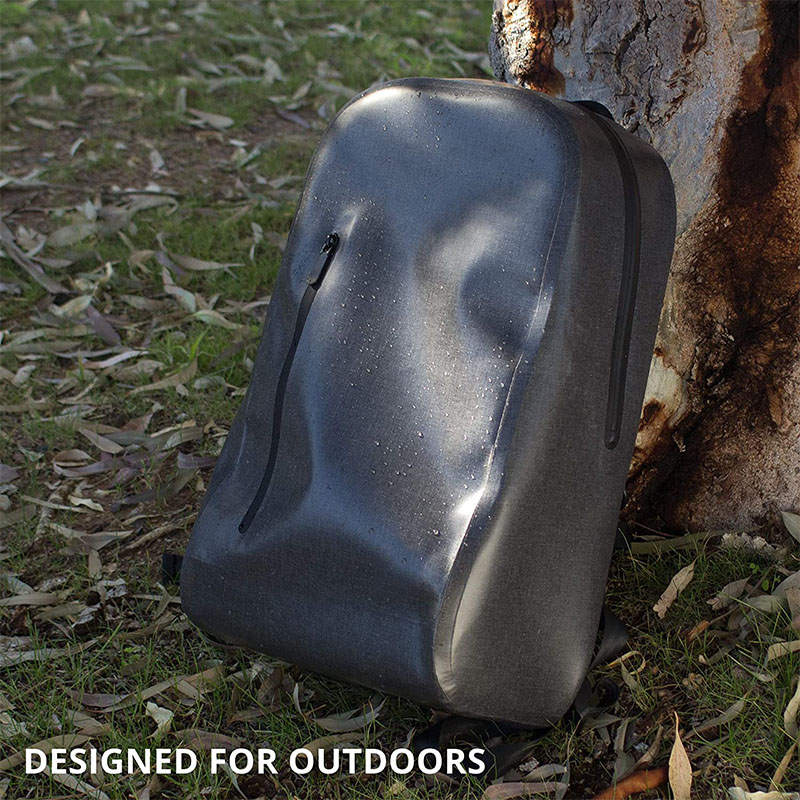
One caution worth stating plainly: an airtight zipper does not by itself establish a certified waterproof rating for the finished pack. If your market requires certification, ask the factory for its airtightness test records before committing — a construction claim and a test report are different documents.
Which one to buy is decided by route, not preference. Coating is enough for drizzle-prone day hikes. For paddling, canyoning or rainforest use, airtight is the only construction that holds.
Airtight performance lives in the welding and the zipper, not the fabric. When you audit a factory for this construction, ask to see the high-frequency welding equipment and the airtight testing step — not a fabric swatch.
Features: The Load-Carrying System
Frame or No Frame
Our range spans three carrying structures, and each has a defined job.
The 55L Frame Pack uses an internal frame with removable stays — and that word "removable" is worth more to a wholesale buyer than it looks:
l With the stays out, the pack flattens, and the carton volume drops accordingly — a freight calculation you can make before you order.
l Stays can be installed per market: heavier loads in Europe, lighter builds elsewhere, from the same production run.
l A bent or broken stay is replaced on its own; the pack is not written off.
The Gray Hiking Daypack takes the opposite route: no frame at all, with air-mesh padded shoulder straps and a back panel doing the work. Below roughly 3–5 kg of load, that is enough — and it saves the weight, cost and complexity of a frame. Above that, a frame is not a luxury; it is what keeps the load off your shoulders.
The Drawstring Mountaineering Pack sits lightest of the three, at 0.75 kg, which is the honest number behind any lightweight claim in this range.
Harness, Sternum Strap and Back Panel
The Gray Hiking Daypack's harness is specific: a low-profile adjustable sternum strap, plus air-mesh on both the straps and the back panel. The 55L Frame Pack adds adjustable comfort straps over its frame.
The commercial point is adjustability. An adjustable sternum strap means one size range fits a wider spread of body types — which converts directly into fewer stock SKUs. For a distributor, that is an inventory decision, not a comfort detail.
event and club buyers should push on adjustment range, because they are fitting strangers; retail buyers should push on how the pack looks worn, because their customer tries it on. The two ask for different harness geometry.
Pockets, Hood and Attachment Points
Storage layout differs by design intent across the four models, and the differences are instructive:
l The 55L Frame Pack pairs a top hood with two quick-access pockets, a large main body, and trekking pole holders for tools you need while moving.
l The Gray Hiking Daypack splits storage into two main compartments, a gusseted shove pocket for a shell, and side-profile daisy chains for external attachment.
l The Drawstring Mountaineering Pack bets on a big drawstring opening plus two side pockets — packing speed over organisation.
l The 20L Airtight Pack has a single sealed compartment and almost no subdivisions.
That last one is not cost-cutting. Every opening in a waterproof pack is a potential leak path, so fewer openings is the price of the seal. If a supplier offers you an airtight pack full of zipped pockets, the two claims are fighting each other.
What Wholesale Buyers Should Check Before Ordering
Range Planning: How Many SKUs, and in What Order
Do not launch all four tiers at once. A workable sequence: start with one volume tier (usually the mid-size or the 14L) plus one high-margin construction (the 20L Airtight Pack), validate the channel, then extend to 55L.
Colour planning follows the same logic: three colourways on the volume model, one or two on the airtight model, whose higher unit cost and slower turnover punish wide colour bets.
One question worth asking any factory: can the tiers share shell fabric and lining specs? Shared specs across a range mean smaller effective minimums, simpler QC and less inventory complexity. It is a supply-chain question that most buyers never think to ask, and the answer tells you how the factory plans production.
MOQ, Sampling and Lead Time
| Item | Detail |
| MOQ | 500 pcs |
| Sample time — regular models | 7–15 days |
| Sample time — airtight TPU | 10–15 days |
| Production time — regular models | 40–60 days |
| Production time — airtight TPU | 45–60 days |
| Port of loading | Xiamen, China |
| Payment | T/T or L/C |
| Packing | 1 pc per PP bag, carton quantity to buyer's requirement |
Two practical notes. The airtight model runs 3–5 days longer at both sampling and production, so it cannot be promised against the same date as the rest of a mixed order. And mixed orders should be grouped by construction — conventional packs in one batch, airtight in another — not sequenced by capacity.
Who Buys Hiking Packs in Bulk
Four buyer types work this category, and their binding constraints differ more than their product briefs do.
Outdoor brands. Differentiation lives in fabric and colour, and the real constraint is batch consistency: a colour that shifts between production runs damages a brand more than a late shipment.
Importers and distributors. They need a range that covers several price points with predictable replenishment, which is why the capacity ladder in section 2 matters more to them than any single model.
Retail chains. Their question is SKU control: one or two volume tiers, colourways that sell, and adjustability that stretches one size across more customers.
Water-sports and specialty channels. For them, airtight waterproofing is the entry ticket, not a selling point — a coated pack is not a discounted option here, it is the wrong product.
Each of these buyers reads the same four variables from section 1 in a different order. A supplier who understands which variable leads for which channel can quote faster and waste less sampling budget on packs that were never going to fit the brief.
Frequently Asked Questions
What size hiking backpack should I stock first?
Decide by channel, not by size. Retail and general outdoor channels start with the mid-size or 14L tier; specialty stores add the 55L; waterproof-focused channels start from the 20L airtight construction.
Is a frame necessary for a hiking backpack?
Below roughly 3–5 kg of load, a frameless pack with a padded air-mesh back panel and an adjustable sternum strap carries well and saves weight and cost. For multi-day loads, an internal frame — ideally with removable stays — is what keeps weight off the shoulders.
What is the difference between water-resistant and airtight?
A coated pack repels spray and light rain but leaves zippers and seams as open paths. An airtight zipper with a TPU body seals the main compartment itself — at higher cost, weight and zipper stiffness. Neither claim substitutes for a test report; choose by route, and verify by sample.
Can hiking backpacks be customized?
Yes — shell fabric, lining spec, colour, logo method, pocket layout, harness and hardware are all adjustable, with an MOQ of 500 pcs and 7–15 day sampling. Custom materials can be tested to REACH where the destination market requires it.
Conclusion: Choose the Right Hiking Backpack for Your Market
Four variables decide this category: capacity sets the structure of your range, fabric sets the cost, the carrying system sets the experience, and waterproofing decides which channel the pack can be sold into. Get all four aligned with your market, and you have a range that sells without coming back.
The models used as examples here — the 55L Frame Pack, the Drawstring Mountaineering Pack, the Gray Hiking Daypack and the 20L Airtight Pack — cover 14L to 55L across three constructions, and can all be reviewed in the hiking backpacks category. If your range also serves running and event channels, the complementary carrying option is covered in hydration backpacks for outdoor running.
For samples, capacity planning or an OEM/ODM brief, contact us. As the hiking backpack manufacturer behind the range above, we will map your market to the right construction before you commit to a deposit.

